
Setu Bandhasana (Bridge pose)
Supine position with knees bent, feet on the floor, buttocks and back raised off the floor creating a ‘bridge’ with the body, shoulders and arms resting on the floor. Arms are extended along the sides, palms facing down.
Media
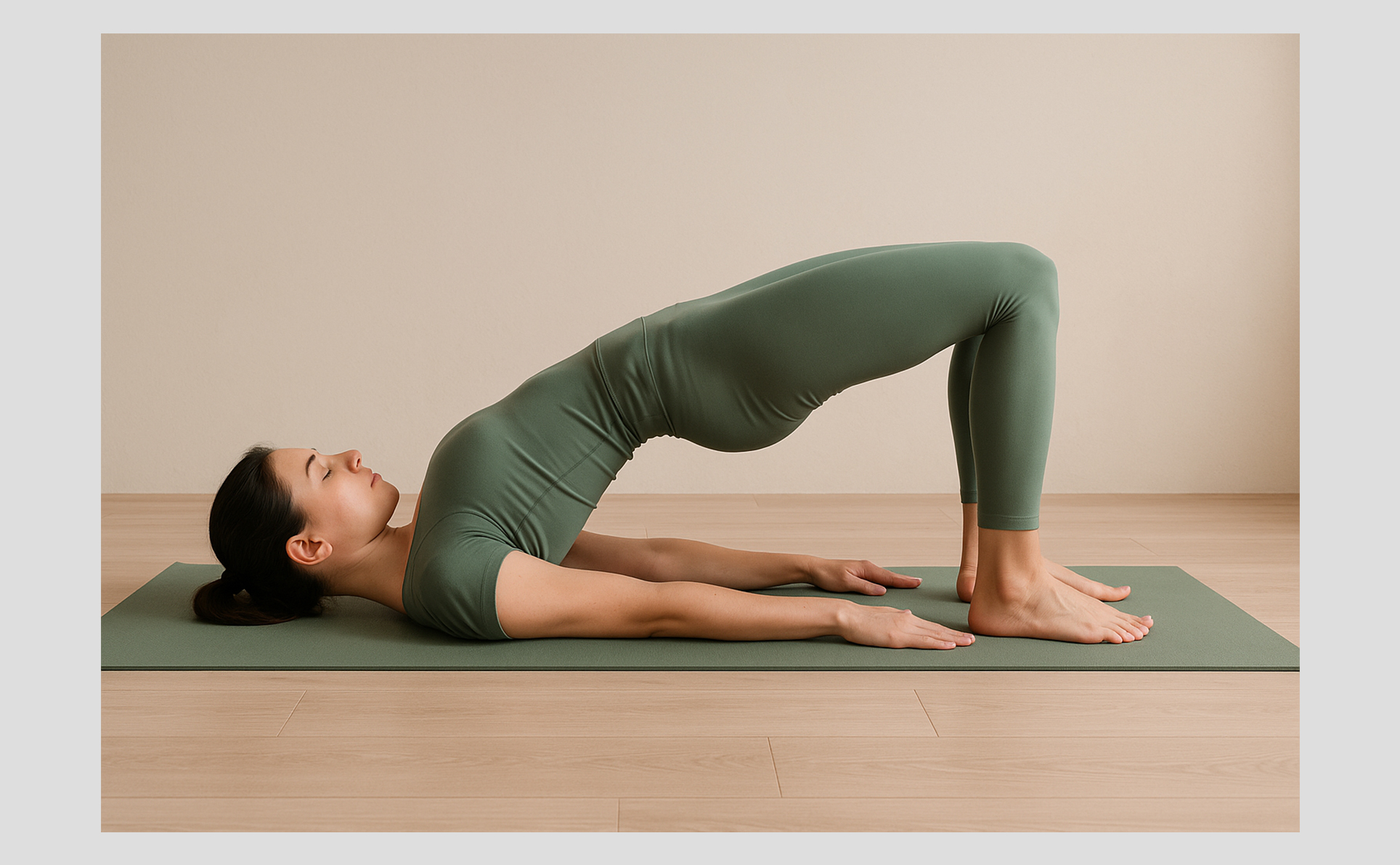
Instructions
Lie on your back, legs bent, feet parallel and well supported on the mat.
Place feet hip-width apart, close to but not in contact with the buttocks.
Position your arms along your sides, palms facing down.
Inhale deeply.
As you exhale, push your feet against the ground, activate your glutes and slowly lift your pelvis upward, one vertebra at a time.
Bring your hips in line with your knees and shoulders.
Hold the position.
Keep glutes and hamstrings active, avoiding pushing too hard from the lower back.
Exit the position: Exhale slowly and lower the pelvis to the floor, one vertebra at a time, starting from the shoulders toward the buttocks.
Relax the whole body.
Exercise Details
Repetitions
3/4 reps
Hold Time
45 seconds
Breathing
Inhale preparing, exhale raising hips. Deep breathing while holding, expanding chest.
Important Warnings
People with cervical or upper spine problems:
The position unloads some of the weight on the shoulders and neck. In cases of cervical hernia, spondylosis or stiffness, it can worsen symptoms. Avoid rotating the head while holding. You may want to use a folded blanket under the shoulders to protect the cervical spine.
People with lumbar disc herniation or chronic low back pain:
Extending the lumbar spine can accentuate lordosis and cause compression. It is recommended to use supports under the pelvis (yoga block or bolster), engage the deep abdominal muscles well, and avoid the position if it causes pain.
Hypertension or heart problems:
Opening the chest and cervical extension can cause dizziness or discomfort in those with high blood pressure. A supported version with bolsters under the back is recommended.
Pregnant women:
In the second and third trimesters, supine position can create compression on the vena cava and limit venous return. It is recommended to avoid dynamic version after the first trimester and to perform only bolster-supported version if authorized by the physician
Quick Info
Related Exercises
Beginner • 6min
Intermediate • 3min
Beginner • 2min
Advanced • 3min